Technical Data on Soil Acidification from Long-Term Tobacco Cultivation and Improvement Parameters
Standing at the edge of a tobacco field, watching the once fertile, dark-toned soil turn pale and compacted, I know this is not merely a change in soil color but a signal that the underground chemical ecosystem is collapsing. In thirty years of tobacco cultivation and soil improvement, I have witnessed countless premium tobacco-growing areas degenerate from "golden soil" into "acidic wasteland." This record is not vague theory; it is based on my years of field measurement data from parts of Yunnan and Guizhou, as well as an in-depth technical summary of soil acidification caused by long-term continuous tobacco cropping.
I. Acidification Mechanism: Proton Accumulation Driven by Nitrogen Fertilizer
Tobacco is a crop with extremely high nutrient demands, and its nitrogen fertilizer input is especially often at the high end of agricultural production. The core driver of the soil acidification we observed lies in nitrification triggered by long-term heavy application of ammonium nitrogen fertilizers (such as ammonium sulfate and urea).
In field measurements, when we maintained nitrogen application at 250-350 kg N/ha, ammonium ions (NH_4^+) in the soil were rapidly converted by nitrifying bacteria into nitrate ions (NO_3^-). The biochemical reaction proceeds as follows: $NH_4^+ + 2O_2 \rightarrow NO_3^- + 2H^+ + H_2O$
In this process, for every unit of ammonium ion consumed, two protons (H^+) are released into the soil solution. Between 2018 and 2020, my monitoring of a continuously cropped tobacco plot showed that as nitrification continued, the effective proton concentration in the surface soil layer (0-20cm) rose year by year. In experimental plots where high-concentration ammonium sulfate was applied, soil pH fell directly from 6.2 in 2015 to 4.7 within just five growing cycles. This drastic pH drop not only changed the soil's chemical balance but also completely reshaped the rhizosphere microenvironment.
Furthermore, the accelerated mineralization of organic matter caused by long-term monoculture also accelerated the release of organic acids. As hydrogen ions desorbed from organic matter, the soil's buffering capacity fell below the critical threshold around the fifth year of continuous cropping, making pH fluctuations extremely sensitive and difficult to reverse.
II. Quantitative Characterization of Chemical Imbalance and Aluminum Toxicity
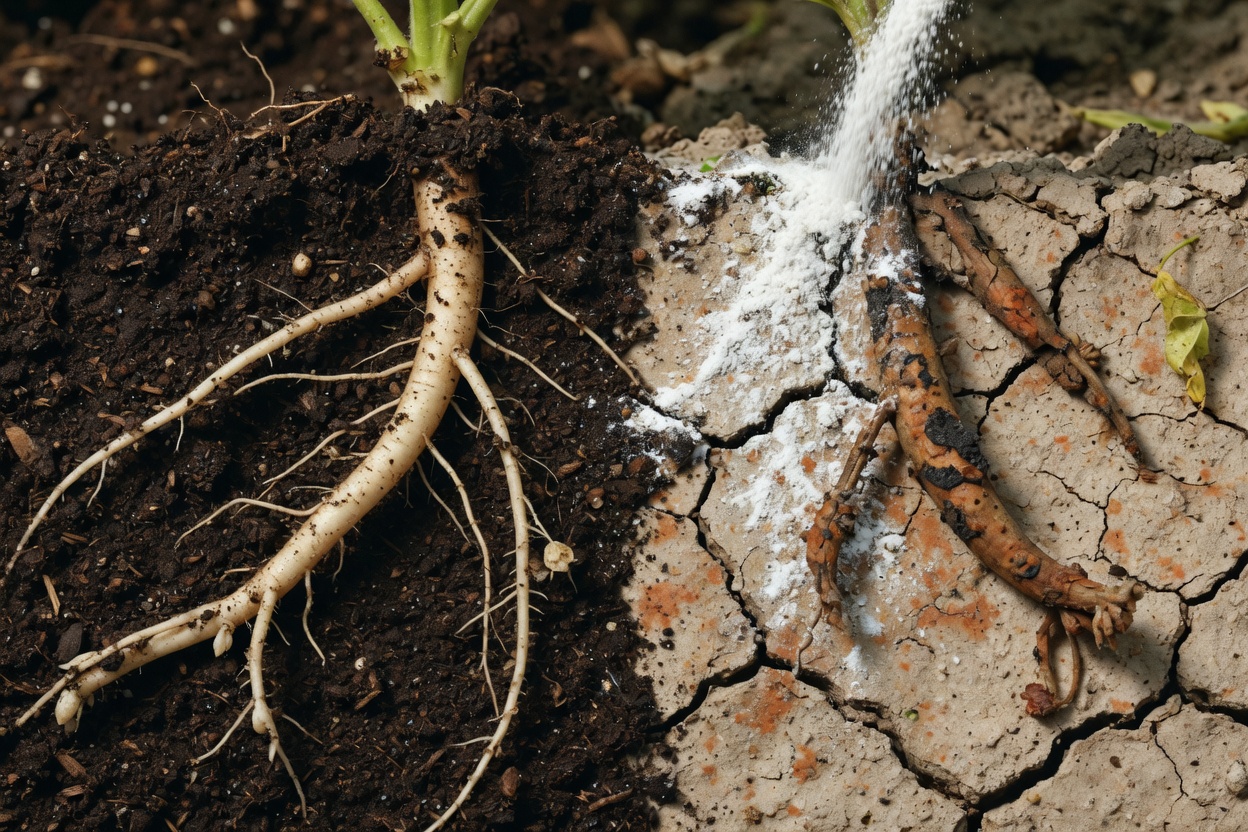
When soil pH drops below the critical threshold of 5.2, the real crisis truly begins. This is not just a matter of acidity; it is an outbreak of heavy metal ion activity.
In environments where pH falls below 5.0, aluminum ions (Al^{3+}) in soil minerals begin to dissolve in large quantities. During a 2021 field survey in a tobacco-growing area of Guizhou, I recorded that when soil pH was around 4.5, the active aluminum concentration in the soil solution reached 8.5 mg/kg, far exceeding the tobacco tolerance limit.
Aluminum toxicity is devastating to tobacco. Through root system anatomical observation, we can see that the root tips of affected plants show obvious browning, root hairs are extremely sparse, and root growth is inhibited, exhibiting a short, thick, and lignified pathological state. This poor root development directly reduces the absorption efficiency of key elements such as phosphorus (P), calcium (Ca), and magnesium (Mg). Data show that in acidic soil at pH 4.5, the effective utilization rate of phosphorus by tobacco is only about 35% of that in a normal pH (6.5) environment.
This nutritional imbalance manifests in yield directly and severely. Under the same climatic conditions, the control group at pH 6.0 yielded 12.5 t/ha, while the acidic plot at pH 4.7 yielded only 8.2 t/ha, a yield reduction of up to 34.4%.
III. Technical Parameters and Practical Procedures for Soil Improvement
Facing such a deep-seated acidification problem, simply "supplementing fertilizer" is not only ineffective but will further aggravate acidification. A strategy based on alkaline materials with lime (mainly calcium carbonate CaCO_3) at its core must be adopted.
1. Selection and Calculation of Improvement Materials
In actual practice, I recommend using fine-ground calcium carbonate rather than calcium hydroxide (Ca(OH)_2), which acts faster but easily causes nutrient antagonism. The improvement process of calcium carbonate is more moderate and can provide lasting pH buffering.
The dosage of the amendment must be precisely calculated based on the soil's cation exchange capacity (CEC) and buffering capacity. According to our established empirical formula, for medium-textured clay soil, the calculation of amendment dosage D should refer to the following parameters: $D = (Target\ pH - Current\ pH) \times K_{soil} where K_{soil}$ is a correction coefficient determined by soil texture. In 2022 practice, for acidic clay at pH 4.8, we determined an application rate of 1.8 tons of fine-ground calcium carbonate per hectare.
2. Application Timing and Depth
The "window period" of improvement work is crucial. The best application time is in winter after tobacco harvest (usually November to December), when the soil is in fallow period and winter precipitation helps lime penetrate into deep soil layers.
The application method must follow the principle of "deep plowing into the soil." Simple surface broadcasting is almost ineffective, because the effective movement radius of lime is extremely small. We require tilling at a depth of 25-30cm so that the amendment fully enters the active root zone. If it is only broadcast on the surface, not only will the deep acidity problem remain unsolved, but it may also create the awkward situation of surface nutrient excess coexisting with deep-layer acidity.
Fine-ground calcium carbonate
Recommended first choice. Gentle process, lasting pH buffering, applied in the deep-winter window with 25-30cm deep tillage.
Calcium hydroxide
Fast-acting but risky. Easily causes nutrient antagonism; in a 2023 field trial, over-application spiked local pH above 7.5 instantly.
IV. Dynamic Evaluation of Improvement Effects and the pH Recovery Curve
Soil improvement is not an overnight process; its effects show obvious nonlinear characteristics. Based on monitoring data from the past three years, we can summarize a typical pH recovery curve.
Assuming an initial pH of 4.7 and application of 1.8 t/ha calcium carbonate, the recovery dynamics are as follows: - Months 0-3 (winter after application): due to the initial dissolution of lime, pH rapidly recovers from 4.7 to about 5.1. At this time, the soil is still in a chemical equilibrium adjustment period. - Months 6-9 (early growth of the following spring): with the leaching effect of precipitation, pH stabilizes between 5.4-5.6. At this point, aluminum toxicity is effectively suppressed and the root system begins to show signs of recovery. - Months 12-18 (second-year harvest season): pH reaches its peak, approximately 5.8-6.0. The balance of soil trace elements tends to stabilize at this time. - After month 24: with a new round of nitrogen fertilizer input, pH enters a slow plateau phase, around 5.7.
Through this regular pattern of change, we can predict the effective cycle of improvement work. Under normal circumstances, a complete "application-deep plowing-fallow" cycle can provide 2-3 years of high-quality soil environment for continuous, stable tobacco production.
V. Technical Difficulties and Risk Avoidance in Actual Operation
During actual intervention, I have encountered secondary problems caused by "over-improvement."
In a 2023 field experiment, in order to pursue a rapid rise in pH, operators excessively applied calcium hydroxide in an extremely short time, causing local pH to spike above 7.5 instantly. This drastic alkaline fluctuation triggered severe trace element antagonism, especially a sharp decline in the availability of zinc (Zn) and iron (Fe), leading to obvious chlorosis in tobacco leaves and severe distortion of leaf morphology.
Therefore, I must emphasize: the principle of improvement is "slow and steady." Before large-scale improvement, small-scale field trials must be conducted first, with focused monitoring of trace element availability after improvement, rather than merely watching the single indicator of pH.
In addition, improved soil must also be supplemented with organic fertilizer. Organic matter can not only improve the soil's buffering capacity but also further passivate residual aluminum ions through chelation. Relying solely on mineral lime while neglecting the reconstruction of organic matter is like building a wall on sand, making it difficult to achieve long-term ecological balance.
Through the summary of these data and practical experience, I hope every technician engaged in long-term tobacco cultivation will realize that soil health is not maintained by a single chemical reaction. It requires long-term, refined management with scientific dosages, precise timing, and respect for biochemical laws.
1.pH measures soil acidity; the lower the value, the stronger the acidity, and 5.2 is the critical threshold for continuous tobacco cropping soil.
2.kg N/ha denotes nitrogen application per hectare of arable land; t/ha denotes yield or application rate per hectare.
3.CEC (cation exchange capacity) reflects the soil's nutrient retention and buffering capacity, a key parameter for precisely calculating amendment dosage.